In modern CNC manufacturing, every detail matters — literally. But scrap is not just a production defect. It is a mathematical reflection of how our process behaves over time.
Scrap as a Dynamic System — Engineering Beyond the Surface
To truly understand and control scrap, I treat it as a dynamic model — a time-dependent function of product quality, equipment condition, and process parameters.
In this approach, scrap is not just “bad parts”, but a visible output of an invisible system behaviour that evolves with every cycle, tool wear, and micro-adjustment on the shop floor.
From Scrap to System: A Mathematical View
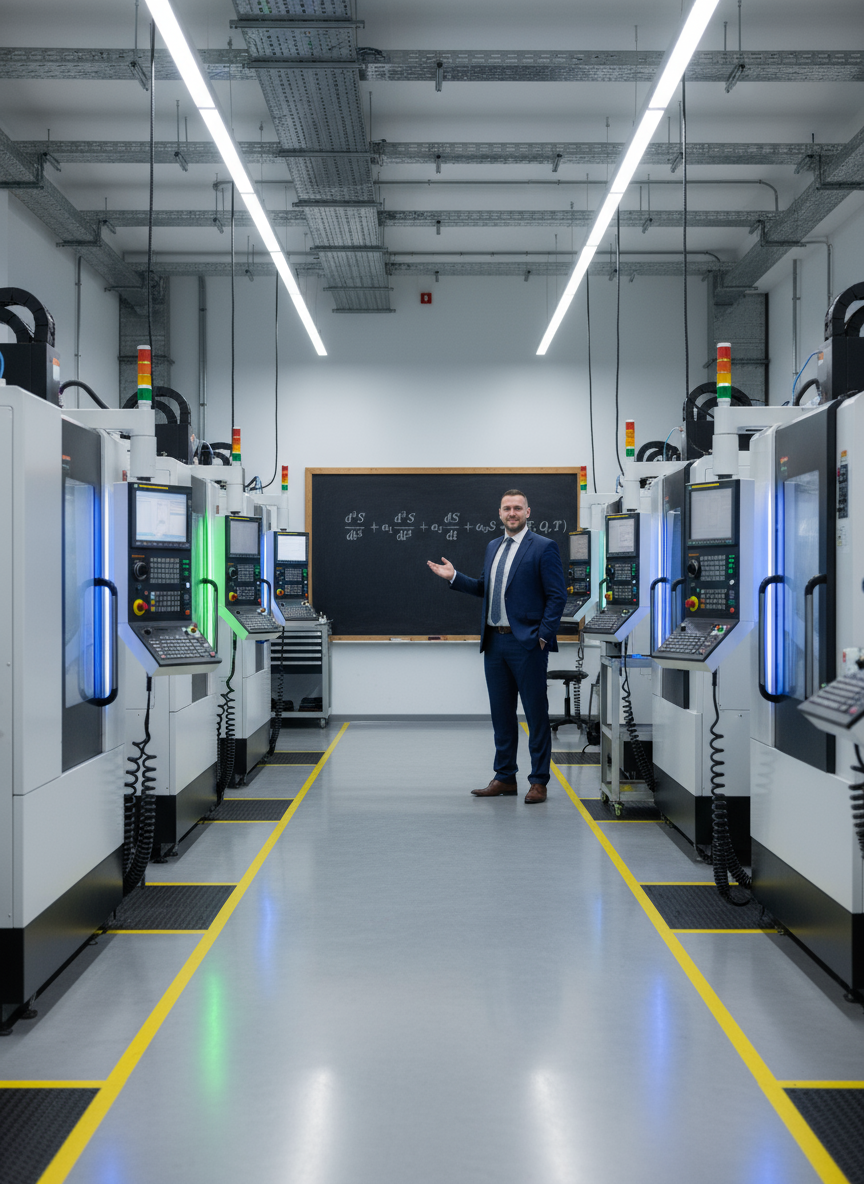
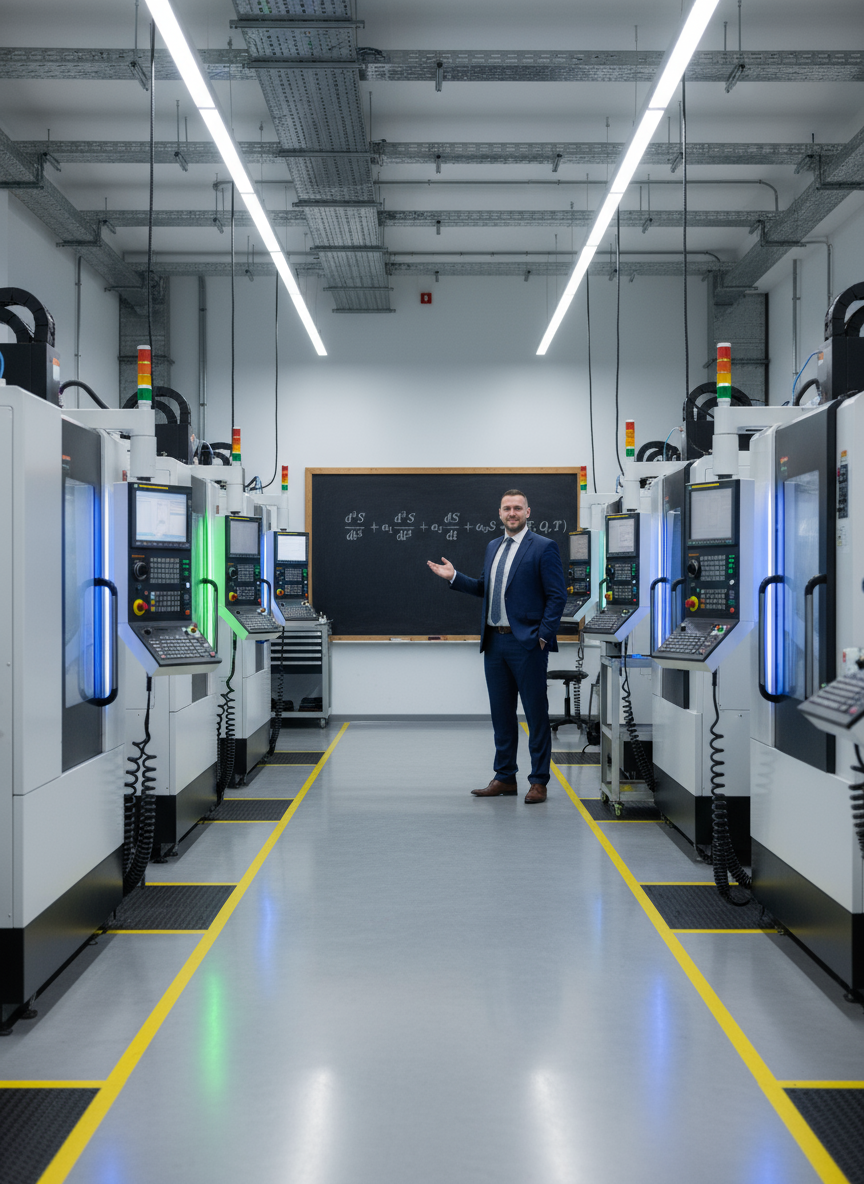
I describe this system using a third-order differential equation, capturing how variations develop and influence the final result over time.
By applying advanced numerical methods such as Runge–Kutta, Euler, or Adams, it becomes possible to:
- simulate the process behaviour with high accuracy,
- forecast instability long before it becomes visible,
- predict where and when scrap is likely to appear.
Reducing the Model for Real-Time Control
To make the solution practical for a real workshop, I reduce the third-order model to a set of first-order equations.
This allows:
- real-time computation,
- integration into process control systems,
- use of live production data (tool wear, cycle times, inspection results).
Building a Feedback Control System
Once the mathematical model is defined, I build a feedback control system, where a state vector interacts within a matrix structure that represents the process.
In practical terms, this means:
- the system continuously “reads” its own state,
- predicts how current conditions will impact scrap levels,
- adjusts key parameters to stabilise production in real time.
The result is an optimal control rule — a closed loop that naturally suppresses the growth of scrap while keeping cost low and efficiency high.
When Mathematics Meets Manufacturing
When we bring mathematics into manufacturing at this level, quality becomes measurable, predictable, and controllable.
Scrap stops being a “necessary loss” and becomes a signal — a precise indicator that helps us tune the system, improve stability, and design processes that are robust by default.
👉 Question for reflection:
How does your workshop treat scrap today — as a random cost of doing business,
or as a system signal that can be modelled, predicted, and reduced?