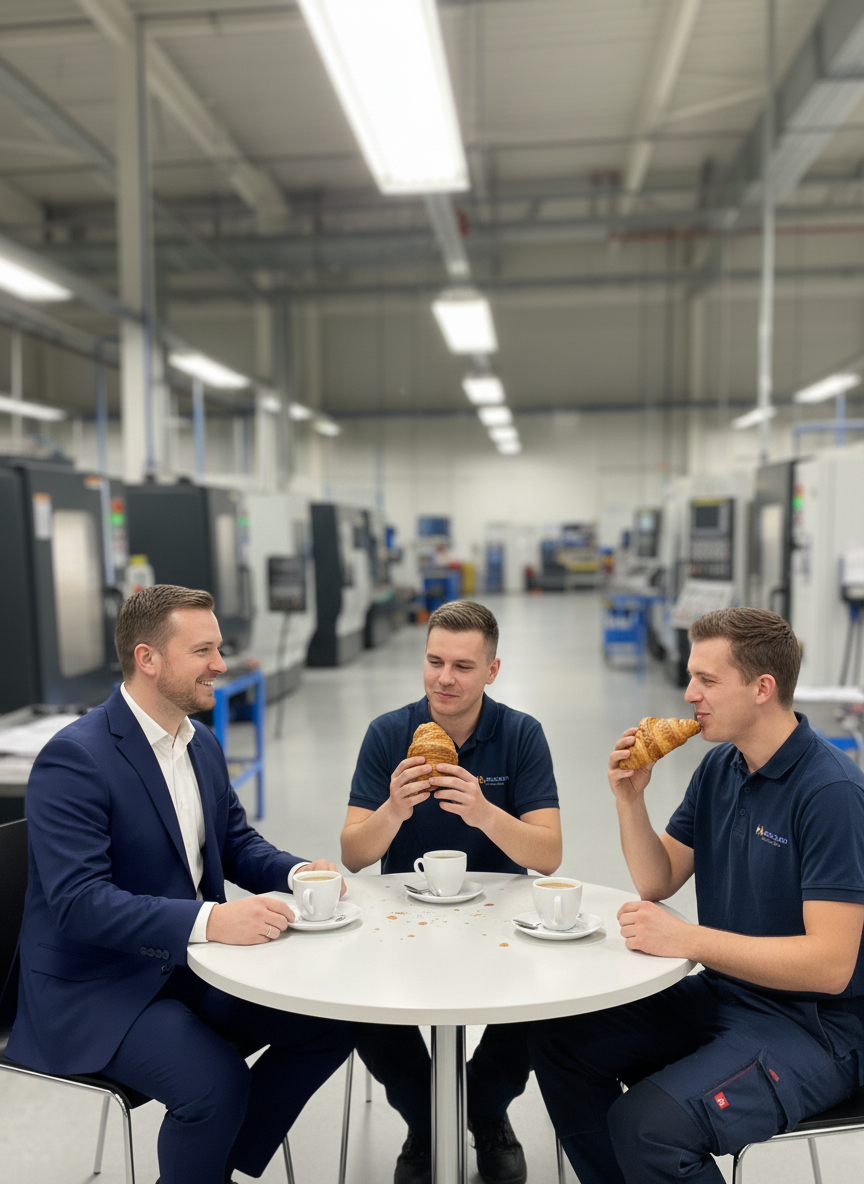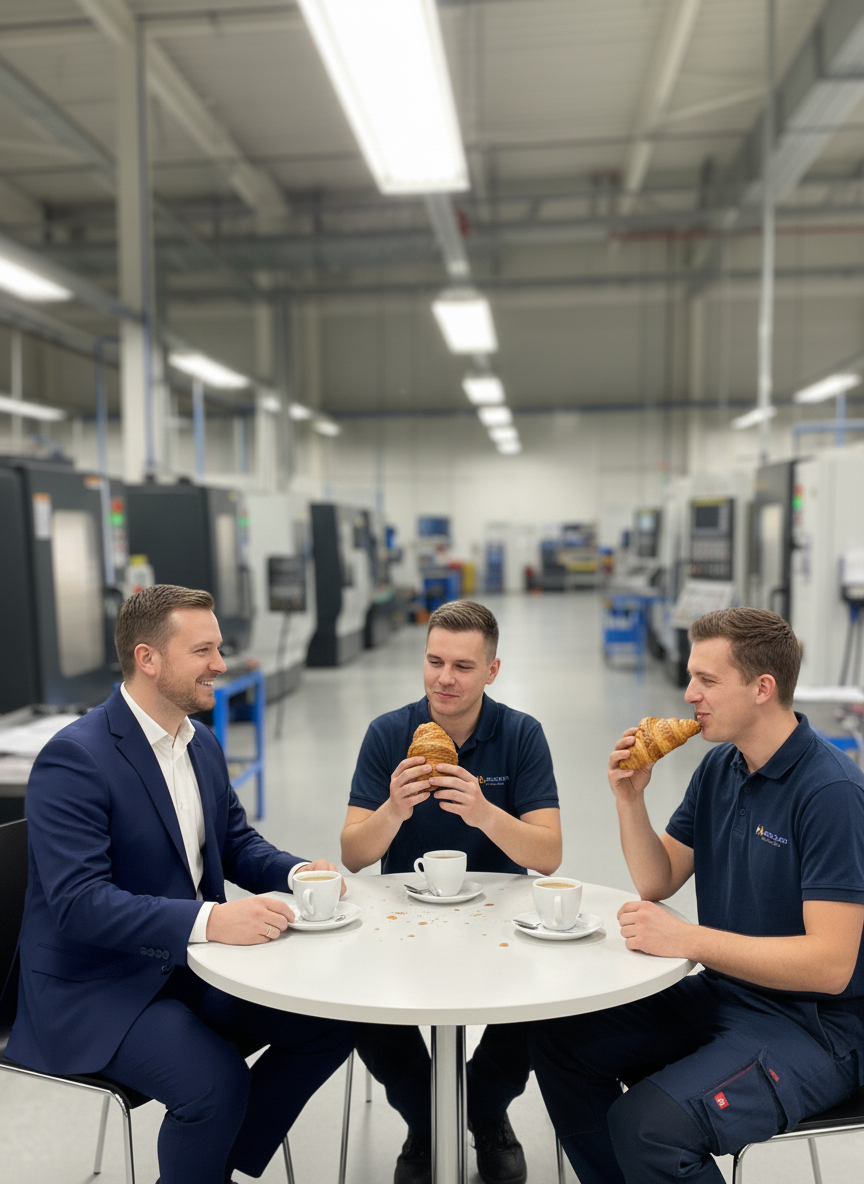
Reading Simon Sinek’s “Leaders Eat Last” deeply resonated with my daily life in a CNC machine shop — where safety, deadlines, quality, and continuous improvement define success.
The core idea is simple yet powerful: leaders create a Circle of Safety where people feel trust, protection, and purpose. In that environment, teams make better decisions, share ideas, and take initiative.
⚙️ Leaders Eat Last: Building High-Trust CNC Teams
On the CNC shop floor, pressure is constant: delivery dates, tight tolerances, cost targets, audits. It is easy to fall into command-and-control leadership.
Sinek’s principles helped me reframe leadership as a responsibility to protect and equip people — not just to demand results. Below is how I apply these ideas in combination with Lean, TOC, and modern production analytics.
1️⃣ People Before Metrics 👥
Why: Without psychological safety, operators hide problems.
How:
- Weekly EHS “safety huddles” to discuss risks, near-misses, and 5S/LOTO.
- No-blame incident reviews — fix systems, not people.
- Visual safety and quality boards showing real progress and impact.
Result: more proactive ideas and fewer minor incidents.
2️⃣ Transparency Reduces Anxiety 🔍
Why: Context lowers stress and resistance.
How:
- Visible order queues and priorities in MES/APS — clear bottlenecks and workloads.
- Daily Gemba stand-ups reviewing OEE (Availability, Performance, Quality), WIP, and risks.
- Operators involved in SMED planning to stabilise first-piece quality.
Result: fewer “fires”, predictable schedules, smoother shifts.
3️⃣ Servant Leadership Grows People 🌱
Why: Leadership means responsibility for people — not a title.
How:
- Mentorship and skills matrix: metrology, offsets, GD&T understanding.
- Coaching after launches: lessons learned → updated standards.
- Upskilling pathway and pay progression for multi-machine capability.
Result: reduced variation, higher confidence, faster adoption.
4️⃣ Feedback Culture Without Fear 💬
Why: Silent teams burn out — problems compound.
How:
- Andon for quality: permission to stop when scrap risk appears.
- Two-way feedback: ask “What can I change to make your work easier?” — and act on it.
- 5 Whys and A3 problem solving: capture learning, find root causes.
Result: scrap reduction and growing trust.
5️⃣ Lead With Purpose, Not Fear 🔆
Why: “Why” beats “what”. People commit when they see meaning.
I use a simple System Tree to show how daily work creates value:
- Planning & Control — MES, OEE, APS.
- Equipment Management — TPM, setup standards.
- Quality Management — SPC, Poka-Yoke, FAI/PPAP.
- Workforce Development — training, skills matrix.
- Waste Elimination — 5S, SMED, Kaizen.
Add to this simple recognition rituals for ideas, accuracy, changeovers, scrap reduction, and safety.
Result: work becomes linked to value — for both the customer and the team.
⚙️ Turning Care into Performance on the CNC Shop Floor
I focus on how empathy, structure, and discipline translate into measurable performance on the CNC shop floor.
6️⃣ Balance Short-Term Output with Long-Term Health ⚖️
Why: Chasing today’s numbers at the expense of standards kills tomorrow’s performance.
How:
- Kanban for tooling and consumables — no more downtime over “small” shortages.
- TPM discipline, even during peak weeks, to prevent breakdowns and quality drift.
- Weekly Kaizen cadence — at least one improvement in setup, measurement, program, or fixturing per week.
Result: stable, compounding performance without quality swings.
7️⃣ Use Metrics to Support People, Not Punish Them 📊
Why: Metrics are tools — not whips.
How:
- OEE as a team metric, with individual KPIs aligned to quality and safety (e.g. speed without losing Cp/Cpk).
- Dashboards used as “help signals”, not “gotcha” boards.
- Track improvements delivered, not just output — reward creativity and initiative.
Result: less gaming, more real improvement.
💼 Tangible Business Impact of This Approach
- Reduced scrap and setup times (SMED + coaching + standardisation).
- Improved schedule predictability (MES/APS + daily sync).
- Stronger safety and morale (Circle of Safety + EHS as core).
- Higher OEE through process stability and operator engagement.
🧩 Key Practices I Recommend
- Daily Gemba stand-ups reviewing OEE, WIP, and risks.
- Skills matrix with a visible upskilling path and active mentors.
- Andon and A3 for fast, systemic problem-solving.
- Visual “System Tree” to align teams on how value is created.
- Regular recognition and transparency to sustain trust and motivation.
💡 Final Thought
“Leaders who eat last protect people from external pressure, explain the why, and equip teams to win.” — Simon Sinek
In a CNC environment, that means clear plans, disciplined setups, strong training, and deep respect for the operator. Performance does not come from control — it grows from trust.
If you are on a similar path — building high-trust, high-performance manufacturing teams — I am always open to exchanging methods, templates, and routines that help shops reach the next level.
👉 How do you build a Circle of Safety in your own shop?
Which leadership habits have most improved trust, quality, and performance on your
CNC floor?